At 11am on a July morning, the queue under the Eiffel Tower’s pillars can stretch back for an hour, and that’s before security. Visiting the Eiffel Tower goes smoothly or badly depending on three choices you make before you land in Paris: which ticket, which time slot, and whether you climb.
This guide covers all three. You’ll get the 2026 prices from the official ticket office, a booking rule that changes on 29 September 2026, and the free spots where the view of the tower beats the view from it.
Short version: book online, go early or late, and don’t pay a reseller’s markup unless the official site is sold out.
Eiffel Tower at a glance
- Adult tickets: €14.80 (stairs to the second floor) to €36.70 (lift to the top)
- Hours: usually 9:30am to 11pm, later in summer, with last ascents around 10:45pm
- Time needed: about 2 hours for the second floor, 3 hours with the top
- Nearest stations: Bir-Hakeim (metro line 6) and Champ de Mars-Tour Eiffel (RER C)
- Booking: lift tickets go on sale online up to 60 days ahead
Eiffel Tower tickets: what each one gets you
There are four standard tickets, priced by how high you go and how you get there. These are the official 2026 adult rates:
- Second floor by stairs: €14.80
- Second floor by lift: €23.50
- Top by stairs, then lift: €28.00
- Top by lift all the way: €36.70
Young people aged 12 to 24 pay about half. Children aged 4 to 11 pay between €3.80 and €9.20. Under-4s go free, but they still need a zero-euro ticket. Carry ID for anyone on a reduced rate.
Start with the official Eiffel Tower prices and opening times page. It’s the cheapest source, and a timed ticket from there already skips the ticket-office line. Resellers often charge far more for a “skip-the-line” lift ticket that’s really the same slot.
Paying extra makes sense in two cases: the official site has nothing left for your date, or you actually want someone explaining how the tower was built. In either case, you can compare guided Eiffel Tower summit tours, which often still have space when the direct slots are gone.
Is the top worth the extra €13.20? For a first visit, usually yes. The summit sits at 276 metres and gives you the full 360-degree sweep, plus Gustave Eiffel’s restored little office. But the second floor, at 116 metres, is where Paris still looks like Paris. You can pick out Sacré-Cœur, the gold dome of Les Invalides and the boats on the Seine. If you’re on a tight budget or schedule, the second floor is the better-value view.
Stairs or lift? The new booking rule
The stairs are the smart budget move. It’s 674 steps to the second floor, and most reasonably fit adults manage it in stages, with a breather on the first floor. You save €8.70 compared with the lift, and the stair queue is usually shorter.
You can’t climb all the way, though. Above the second floor, everyone rides the lift. That’s why the €28 stairs-plus-lift ticket is the cheapest way to reach the top.
Here’s the change to know about. From 29 September 2026, stairs tickets must be booked in advance. Turning up and buying a climb on the day is no longer a plan to rely on. Groups of more than nine people, guide included, also have to buy online from that date.
Skip the stairs if you have knee or heart trouble, you’re carrying a toddler, or it’s a hot August afternoon. The staircase is open to the air. The official site is clear that the stairways and the top aren’t suitable for people with limited mobility, so the lift to the second floor is the accessible option.
Best time for visiting the Eiffel Tower
The worst slot is late morning to mid-afternoon in summer. That’s when tour groups and day-trippers all arrive together. Two windows work much better.
First thing. Book the opening slot, which is 9:30am for most of the year. Security is quieter, the platforms are less packed, and you’re back on the ground before the crowds peak.
Late evening. Go up about an hour before sunset and stay for the lights. After dark, the tower sparkles for five minutes at the top of every hour. Watching the city switch on from the second floor is why many travelers rate the evening visit above the daytime one. Sunset slots sell out first, so book them as soon as your dates are fixed.
By season, April to June and September to October give you long evenings without August’s peak crowds. Winter is the quietest time. The top gets cold and windy, though, and the official site itself reminds visitors to wrap up. Summit access can also close in bad weather or at very busy times.
If you’d rather watch the lights from the water, the river boats leave from the quays right below the tower. You can book an evening Seine cruise from the Eiffel Tower for after your visit, so you see the sparkle from both angles.
What you’ll find on each floor
First floor (57 metres)
Most people rush past it. That’s a mistake if you have kids with you. There’s a glass floor section where you look straight down to the esplanade, and Madame Brasserie, the tower’s sit-down restaurant, is on this level. If you take the stairs, you’ll pass through anyway.
Second floor (116 metres)
This is the best all-round viewpoint, with two levels of platforms, snack kiosks and the lift to the top. Le Jules Verne, the tower’s high-end restaurant, is also up here. It’s a serious splurge and books out well ahead.
The top (276 metres)
You switch lifts on the second floor for the ride up. There’s an enclosed lower level and an open-air upper deck, plus the champagne bar. A glass costs extra: the official top-by-lift ticket with champagne is €60.70, against €36.70 without. It’s fun once. It isn’t essential.
Getting there and getting through security
Take public transport. The closest stop is Bir-Hakeim on metro line 6, under 10 minutes’ walk from the entrance on Allée des Refuzniks. Champ de Mars-Tour Eiffel on RER C is about 5 minutes away. Trocadéro (line 9) and École Militaire (line 8) are around 15 minutes on foot, but Trocadéro gives you the classic view on the walk in. The official access map also lists the nearby bus stops.
The area around the base is fenced. Everyone passes an airport-style bag check to reach the esplanade, even if you’re not going up. Entry to the esplanade itself is free.
A few rules that trip people up:
- Large bags and suitcases aren’t allowed, and there’s no left-luggage office. Drop your case at the hotel first.
- Arrive 15 to 20 minutes before your time slot to allow for security.
- Check which pillar your ticket names. Walking to the wrong one eats into your slot.
- Bring ID that matches any youth or child ticket.
Crowds, scams and what’s overrated
Crowds around the tower attract pickpockets and a few well-worn scams. Expect the “sign my petition” clipboard, the found-a-gold-ring trick and shell games near the Pont d’Iéna. Keep walking, keep your phone in a front pocket, and don’t sign anything.
The sellers with rings of miniature towers are persistent but harmless. A firm “non, merci” does the job.
What’s overrated? Paying a premium for a basic skip-the-line ticket when the official site still has slots. Nobody skips security, whatever the ticket says. Also overrated: snack-bar lunches on the second floor at tourist prices, when the food shops of Rue Cler are a short walk away.
The best free views of the tower
Some of the best parts of an Eiffel Tower visit cost nothing at all.
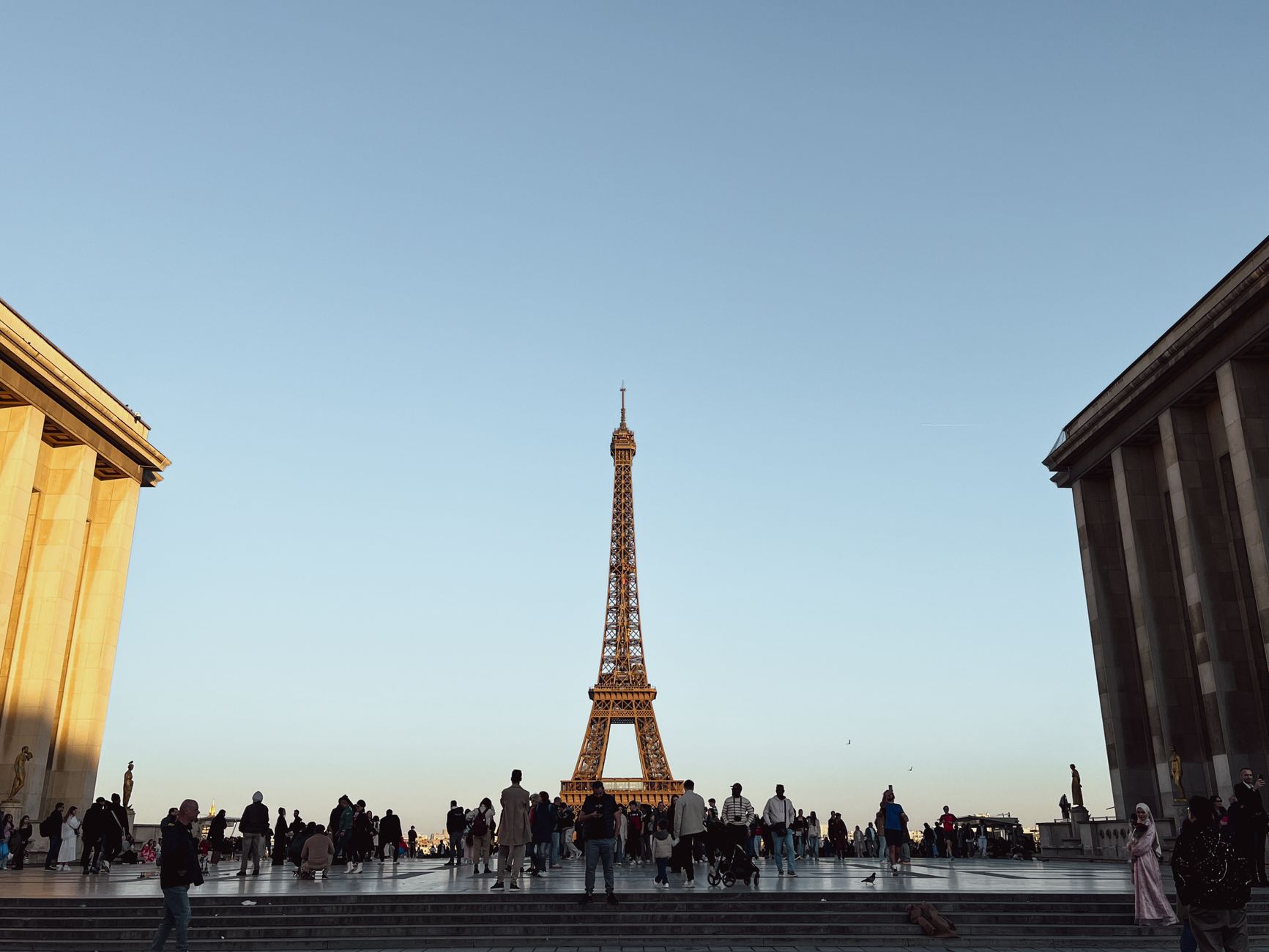
- Trocadéro: the terrace between the two wings of the Palais de Chaillot is the postcard angle. Go early, because it fills up by mid-morning.
- Champ de Mars: the long lawn behind the tower is where Parisians picnic on summer evenings.
- Pont de Bir-Hakeim: the two-level bridge frames the tower well and is calmer than Trocadéro.
- Rue de l’Université: a street shot where the tower rises at the end of a row of cream stone buildings.
Where to stay near the Eiffel Tower
Staying close makes the early and late slots easy, because you can walk back after the last sparkle instead of waiting for a late metro.
The 7th arrondissement, around Rue Cler and École Militaire, is quiet, safe and full of cafés, but it’s one of the pricier parts of Paris. The 15th, around Dupleix and Cambronne, is a short walk further and usually cheaper for the same standard of room. To weigh the two, you can check hotels in the 7th arrondissement and compare them with what the 15th offers for your dates.
Questions travelers ask
Do I need to book Eiffel Tower tickets in advance?
For lift tickets, yes, especially for the top, sunset slots and summer dates. They go on sale online up to 60 days before your visit, and popular slots sell out. From 29 September 2026, stairs tickets need an advance booking too.
How long does visiting the Eiffel Tower take?
Plan on about 2 hours for the second floor and 3 hours if you’re going to the top. That includes security and lift queues. Summer evenings can run longer.
Can you climb the stairs to the top?
No. The public stairs only go as far as the second floor. From there, everyone takes the lift to the summit.
What happens if the top is closed?
The summit can close in strong wind, bad weather or at peak times while the lower floors stay open. Read the ticket terms before you buy so you know what applies, and check the forecast the day before.
One last tip
Book a slot about an hour before sunset. See the city in daylight from the second floor, stay for the first sparkle, then come down and cross the Pont d’Iéna to Trocadéro for the next one on the hour. You get the view from the tower and the view of it in the same evening.
Some links in this post are affiliate links. If you book through them, we may earn a small commission at no extra cost to you.
Cover photo by Chris Karidis on Unsplash

Pingback: Visiting the Louvre: Entrances, Tickets & 3-Hour Route