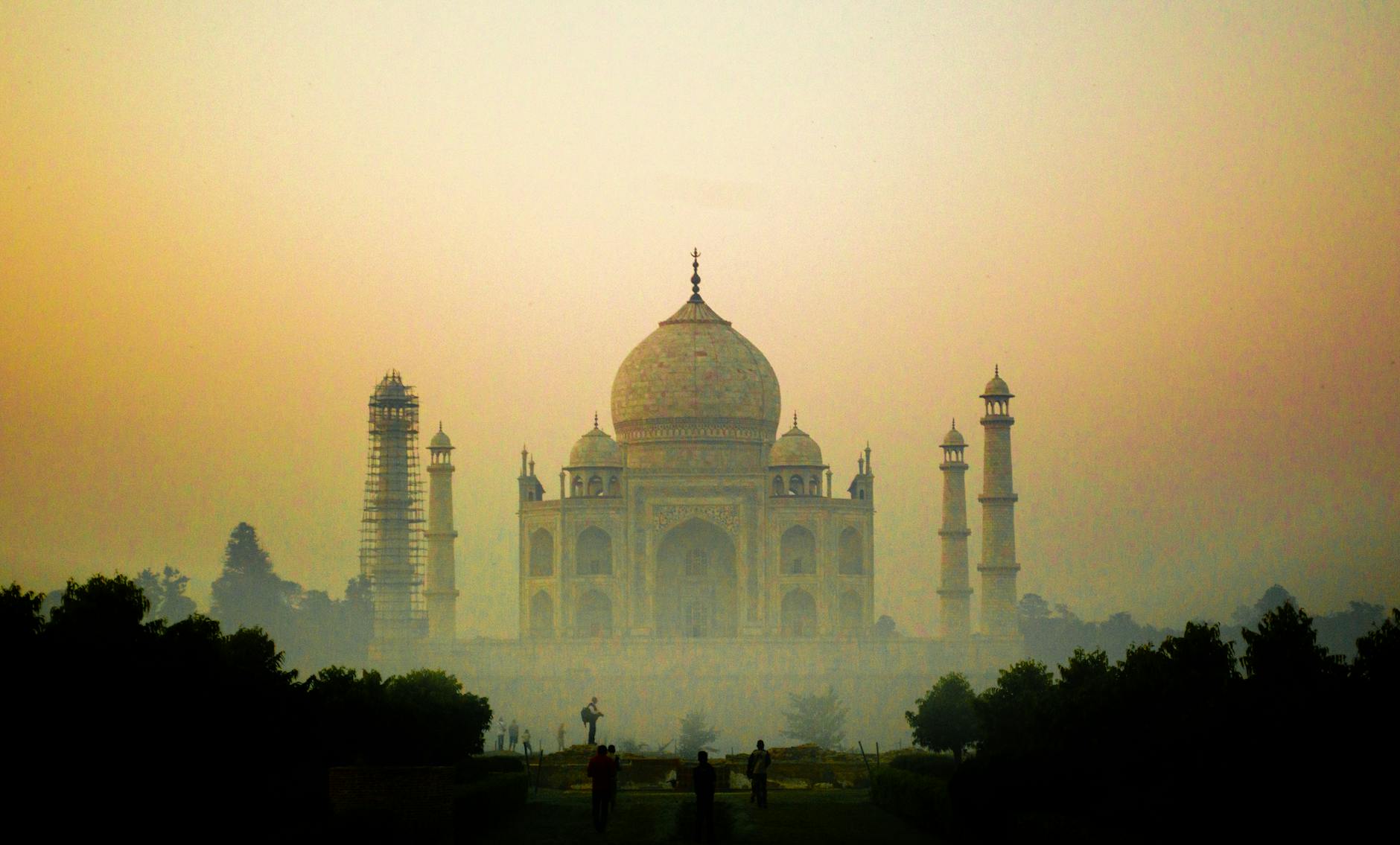
It’s still dark in Agra. A golf cart hums down an empty road, the air smells of woodsmoke and wet earth, and somewhere a temple bell rings. Twenty minutes later you step through a red sandstone arch and there it is: the dome floating in grey-blue light, turning pink, then white. A Taj Mahal sunrise is the one time of day the monument feels like it belongs to you.
It also takes a bit of planning. Pick the wrong gate and you’ll spend the best light in a queue. Forget your ticket details and you’ll be sent back to the counter. Turn up in late December and the whole thing might be wrapped in fog.
This guide sorts all of that: the gate to use, how tickets work, when to arrive and which months give you the clearest skies. For everything else in town, browse our Agra tours and travel guides.
At a glance
- Opening pattern: gates open about 30 minutes before sunrise and close about 30 minutes before sunset.
- Closed: every Friday, for prayers at the mosque inside the complex.
- Best gate for sunrise: the East Gate, via the Shilpgram parking area.
- Tickets: book online a day or two ahead and keep the QR code on your phone.
- Time needed: 2 to 3 hours, a little more if you go inside the mausoleum.
- Best months: October to March, with a fog risk from late December into January.
Why a Taj Mahal sunrise beats every other hour
Three reasons, and they stack up. First, the light. White marble acts like a mirror for the sky, so in the first hour the Taj shifts from lilac to peach to bright white while the red sandstone mosque beside it glows like embers.
Second, the crowds. The Taj Mahal draws millions of visitors a year, and most of them arrive mid-morning on day trips from Delhi or by tour bus. At dawn you can stand at the reflecting pool with only a handful of photographers around you.
Third, the heat. Agra gets properly hot for much of the year, and the marble platform soaks it up. Barefoot or in shoe covers at noon in May? Not fun. At 6am the stone is cool, even cold.
The honest downside: sunrise isn’t always a light show. Haze, cloud and winter fog can flatten the colors, so treat the glow as a bonus and the quiet as the real prize.
The best gate for sunrise (and the one to skip)
The complex has three gates, but only two let you in. No polluting vehicles are allowed within 500 meters of the Taj, so whichever you choose, your driver drops you at a parking area and a free battery bus or golf cart does the last stretch.
East Gate: your sunrise pick
Get dropped at Shilpgram, the official parking and crafts complex, then ride the shuttle to the gate. The East Gate is where most independent travelers and sunrise visitors go because the queues move faster and it’s closest to the bigger hotels along the east side of town. It has a ticket counter and a cloakroom, which matters more than you’d think (see below).
West Gate: fine later, slower at dawn
The West Gate sits on the Taj Ganj side, closer to Agra Fort and the budget guesthouses. It’s handy if you’re walking from that neighborhood, but it’s the busiest entrance and the lines grow fast once domestic tour groups arrive. Travelers often report waits of up to an hour here later in the morning.
South Gate: don’t plan around it
The South Gate has been exit-only for a long stretch, so don’t build a dawn plan around it. Check the official site if you’re staying right next to it.
Taj Mahal tickets without the queue
Prices are set by the Archaeological Survey of India and depend on your nationality. As a rough guide, most foreign visitors pay somewhere around ₹1,100 to ₹1,300 (roughly $13 to $16), citizens of SAARC and BIMSTEC countries pay a reduced rate, Indian citizens pay a small fee, and children under 15 go free. Stepping inside the main mausoleum, where the cenotaphs of Shah Jahan and Mumtaz Mahal sit, costs a small extra ticket on top. Always check the official Taj Mahal visiting page for current prices before you go.
The foreigner ticket comes with a few perks: shoe covers, a small bottle of water and the shuttle ride from the parking area. Bring your passport, since ID can be checked against the ticket.
Should you pay extra for the mausoleum? Yes. The chamber is dim, echoey and surprisingly small, with inlaid flowers of semi-precious stone that catch your phone torch. You’ll be in and out in ten minutes, but you’ll remember it.
A good guide makes the history click, from the calligraphy that seems to stay the same size as it climbs to the reason the minarets lean slightly outward. Skip the men offering cheap tours at the gate: they’re usually unlicensed. If you’d rather have it all arranged, you can book a sunrise tour with a licensed guide who handles the tickets and meets you at the gate.
Timing your sunrise, minute by minute
Sunrise in Agra ranges from a little after 5am in early summer to around 7am in midwinter, so check the time for your date and work backward. Here’s a morning that works:
- 60 minutes before sunrise: leave your hotel. If you’re near the East Gate, the drive is short.
- 45 minutes before: arrive at Shilpgram, hop on the shuttle.
- 30 minutes before: gates open. Be in the line, e-ticket ready.
- First 20 minutes inside: head straight through the Great Gate to the central pools while the garden is empty.
- Next hour: walk up to the marble platform, circle the tomb, visit the mausoleum before the lines build.
- Around 8 to 9am: the tour groups arrive. That’s your cue for breakfast.
Your first view is the best one, so don’t rush it. Pause inside the dark arch of the Great Gate, where the Taj appears perfectly framed at the end of the tunnel. Then walk to the long reflecting pool, and later swing round to the riverside terrace behind the tomb, where the Yamuna slides by and early birds wheel over the water.
Best time of year for a Taj Mahal sunrise
October to March is the sweet spot: dry, comfortable mornings, and cool enough that you’ll want a light jacket at the gate. The catch comes from late December into mid-January, when fog rolls off the Yamuna and can hide the dome completely for hours. Some visitors love the ghostly look. Others leave having seen, well, fog. If you’re set on a clear view, keep a spare morning in your plan.
November can bring haze from crop burning across northern India, which dulls the colors on some days. From April to June, temperatures regularly climb past 40°C, so sunrise isn’t just the prettiest option, it’s the only sane one. The monsoon months, roughly July to September, bring cloud and humidity, but also green lawns and thinner crowds.
Whatever the season, avoid weekends and Indian public holidays if you can. And remember the golden rule: the Taj is closed on Fridays, so don’t make Friday your only day in Agra.
Where to sleep so the alarm hurts less
Doing a sunrise visit as a day trip from Delhi means leaving in the middle of the night, because the express trains arrive long after dawn and the drive takes a few hours. Spend the night in Agra instead. You’ll sleep longer, and you’ll arrive calm instead of car-sick.
For sunrise, stay on the east side of town, around the Fatehabad Road area near Shilpgram, where most mid-range and upscale hotels sit a short ride from the East Gate. Some rooms on the upper floors even catch a view of the dome over the treetops. On a budget? The guesthouses of Taj Ganj put you within walking distance of the West Gate, and several have rooftop cafés facing the Taj for breakfast afterward.
After sunrise: the rest of your Agra morning
You’ll be done by 9am with a whole day ahead. Here’s how to use it:
- Agra Fort: the red sandstone fortress where Shah Jahan spent his last years, with a view back to the Taj from its marble pavilions.
- Itimad-ud-Daulah: nicknamed the Baby Taj, a small, delicate tomb with inlay work that some visitors like even more than the big one.
- Mehtab Bagh: the garden across the river, lined up with the Taj. Save it for late afternoon, when the marble turns gold from the far bank.
Heading on to Delhi, Jaipur or beyond? Our India tours and trip ideas cover the rest of the country. And if more big-name sights are on your list, the same early-bird logic works everywhere: choosing the right entrance to the Louvre saves a similar chunk of queue time.
Questions travelers ask
Is the Taj Mahal open on Fridays?
No. The Taj closes to general visitors every Friday so worshippers can use the mosque inside the complex. It reopens on Saturday at the usual time, about 30 minutes before sunrise.
How early should I arrive for a Taj Mahal sunrise?
Aim to reach the parking area at least 45 minutes before sunrise, so you’re in the security line when the gates open. With an online ticket, you can be inside the garden before the sky starts to color.
Is the extra mausoleum ticket worth it?
For most visitors, yes. It’s a small add-on, and the inner chamber with its marble screens and stone inlay is the heart of the whole monument. Go early, before the line on the platform builds.
Can you see the Taj Mahal at night?
Yes, on a few nights around each full moon, in short, small-group time slots with a limited number of tickets. You view it from a set distance, not up close, and Fridays are excluded. Tickets are sold separately, so check the official site well ahead.
Which is better, sunrise or sunset?
Sunrise wins for quiet, cool air and soft light inside the complex. For sunset, many travelers prefer the view from Mehtab Bagh across the river, which avoids the late-afternoon crowds inside the gardens.
One last thing: pack a pair of socks. On a winter morning the marble platform is freezing underfoot, and warm toes are the difference between lingering by the tomb for an hour and sprinting back to the golf cart. The Taj was built as a monument to love, and it quietly rewards the people who get up early for it. Brush up on the story before you go on the UNESCO World Heritage page for the Taj Mahal.
Some links in this post are affiliate links. If you book through them, we may earn a small commission at no extra cost to you.
Cover photo by Dmitry Voronov on Pexels