It’s just after 8am in Florida City. The last strip-mall gas station fades in the mirror, mangroves close in on both sides, and then the road lifts you over open water that shifts from jade to turquoise to navy. That’s the start of a Florida Keys road trip, and the first bridge makes it very hard to keep your eyes on the lane.
The drive from Miami to Key West is only about 160 miles, and you could do it straight in under four hours. Please don’t. The good stuff sits just off the highway: a reef you can snorkel, giant fish that leap for your snack, a turtle hospital, a white-sand beach under a rusting railway bridge, and a sunset party at the very end of the road.
This guide walks you down the Overseas Highway stop by stop, with what’s worth the detour, what you can skip and how to pace it so you arrive in Key West happy instead of frazzled. For tours and more ideas along the island chain, keep our Florida Keys tours and guides open in another tab.
- Distance: about 160 miles from Miami; the Overseas Highway itself is 113 miles and 42 bridges from Florida City to Key West
- Drive time: 3.5 to 4 hours with no stops; a full day with a few; 2 to 3 days to do it properly
- Best time: December to April for dry weather, late April and May for fewer crowds
- Budget: park entries are cheap; boat trips and Key West hotels are where the money goes
Before you start your Florida Keys road trip
The Keys run on mile markers, not street numbers. They count down from around MM 127 at Florida City to MM 0 in Key West, and almost every address you’ll see uses them. “MM 77.5, bayside” means 77.5 miles from Key West, on the Florida Bay side of the road rather than the Atlantic side.
There’s one road in and one road out. From Florida City you choose between the direct “18-Mile Stretch” of US-1 or Card Sound Road, a quieter toll route through the mangroves that passes Alabama Jack’s, a ramshackle waterfront bar that’s a favorite with bikers and road trippers. Both rejoin in Key Largo and take roughly the same time when traffic is normal.
The Overseas Highway itself is toll-free, but getting to it from Miami usually means Florida’s Turnpike, and there are no cash booths.
Two more things locals will tell you: avoid heading south on a Friday afternoon, when the first stretch out of the mainland backs up badly, and don’t stop on a bridge for photos. Use the marked pull-offs instead.
One day or three? Pacing your Florida Keys road trip
You can see the highlights of a Florida Keys road trip in a single long day, but the Keys reward slowness. Here’s how the two versions look.
If you only have one day, leave Miami early and keep it to four stops:
- Morning snorkel or glass-bottom boat at John Pennekamp in Key Largo
- Tarpon feeding and a waterfront lunch at Robbie’s in Islamorada
- A walk on the Old Seven Mile Bridge in Marathon
- Sunset at Mallory Square in Key West
With three days, sleep in Islamorada or Marathon on night one, spend night two and three in Key West, and use the extra time for the Turtle Hospital, Bahia Honda’s beaches and a boat day out to the Dry Tortugas. That’s the version most travelers wish they’d booked.
Key Largo: get in the water first (MM 106 to 91)
Key Largo is the first big island you hit, and it’s where the reef is closest to hand. John Pennekamp Coral Reef State Park at MM 102.5 was the first undersea park in the United States, and the coral you came for sits a few miles offshore, so you reach it by boat.
Snorkel trips head out several times a day to shallow reefs where parrotfish graze and barracuda hang motionless in the blue. The famous stop is Christ of the Abyss, a bronze statue about eight and a half feet tall standing in roughly 25 feet of water, arms raised toward the light. Not a swimmer? The glass-bottom boat shows you the same reef without getting your hair wet.
Park entry is charged per car and is one of the best deals in the Keys; boat trips cost extra, so check the official park site for current prices. Seats on the morning boats go first, especially on winter weekends, so it’s worth lining up a Key Largo reef snorkel trip before you set off.
Honest note: the park’s beaches are small and rocky. The reef is the reason to stop, not the sand.
Islamorada: feed the tarpon, stay for lunch (MM 90 to 70)
Islamorada calls itself a sport-fishing capital, and at Robbie’s (MM 77.5) you’ll see why in about ten seconds. Pay a few dollars to walk onto the dock, a few more for a bucket of baitfish, then kneel and dangle one over the water.
The water explodes. A silver tarpon, some longer than six feet, lunges up and inhales the fish, and the whole dock shrieks. Tarpon have no sharp teeth, so a brave hand-feeder gets a sandpaper bump rather than a bite. The real threat is the pelicans, who will happily mug you for the bucket.
Stay for lunch at the Hungry Tarpon, the old fish shack on the same property, where you can eat on the deck and watch the chaos continue. If you’ve got an afternoon spare, rent a kayak and paddle 30 to 45 minutes out to Indian Key, an uninhabited island where you can walk the old streets of a vanished village.
Marathon and the Seven Mile Bridge
Marathon sits roughly halfway down the chain and has two stops you shouldn’t rush.
The Turtle Hospital at MM 48.5 is a working animal hospital, and you can only get in on a guided tour of about 90 minutes. You’ll see the X-ray room, meet patients recovering from boat strikes and fishing-line tangles, and usually get to feed a few of the turtles at the end. Tours often fill up, so reserve ahead by phone or on the hospital’s website; you pay on arrival.
Then comes the moment the whole Florida Keys road trip builds toward. The Seven Mile Bridge starts just past MM 47, and for close to seven miles there’s nothing on either side but water: the Atlantic on your left, the Gulf on your right, the sky enormous. Keep the windows down.
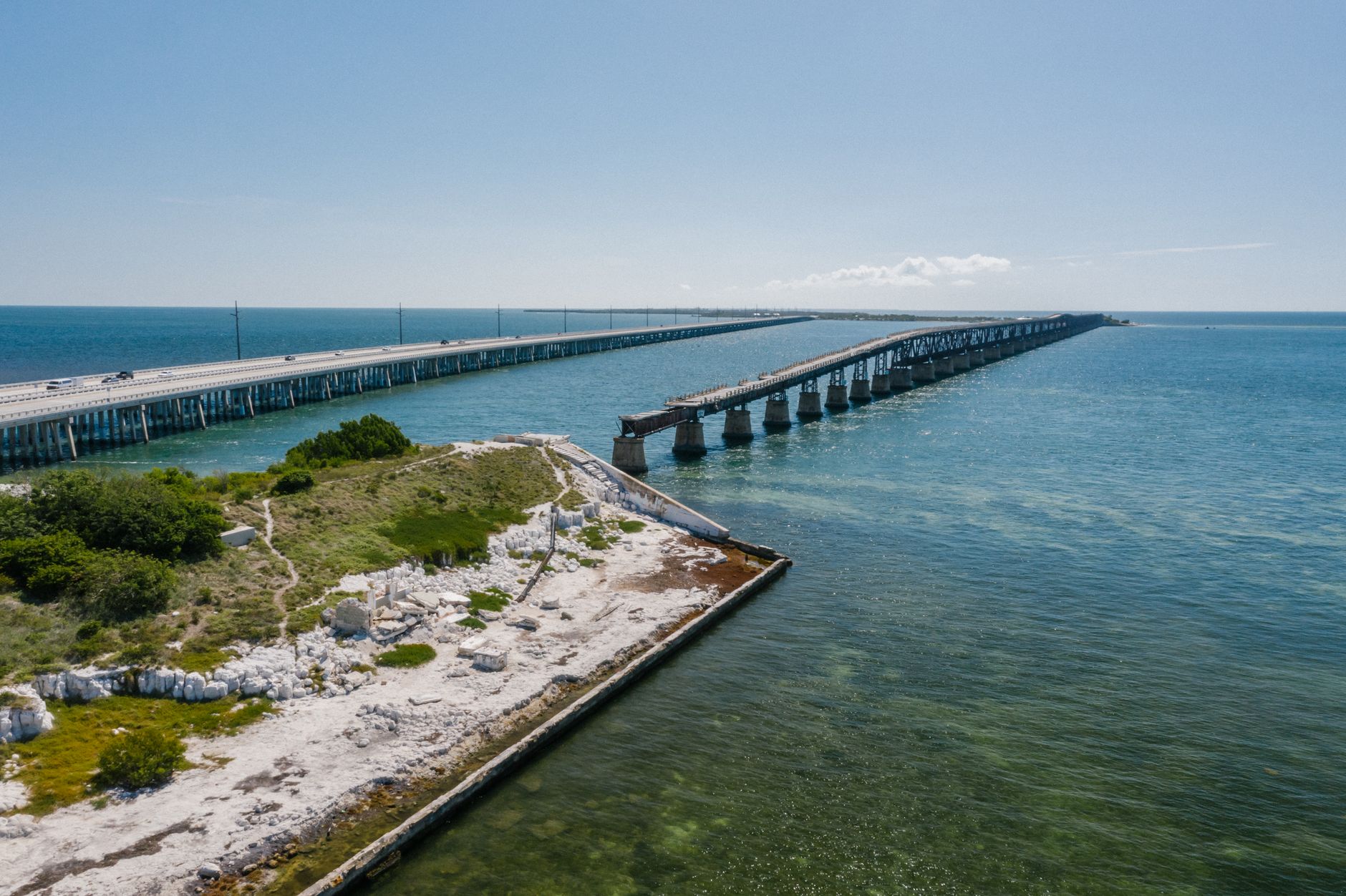
Running alongside it is the Old Seven Mile Bridge, part of Henry Flagler’s railroad a century ago. A restored 2.2-mile section is now a car-free path, free to walk or bike, and people spot eagle rays, sharks and turtles gliding below. At the end is Pigeon Key, the tiny island where railroad workers once lived; entry to the island and its museum costs extra, and there’s a little tram if you’d rather not walk both ways.
The Lower Keys: Bahia Honda and the Key deer (MM 37 to 10)
This is the stretch of the Florida Keys road trip where the islands get quieter, greener and more wild. Most of the chain has rocky, coral shorelines, which is why Bahia Honda State Park (around MM 37) feels like a small miracle: real soft sand and shallow water so clear you can count the ripples on the bottom.
Pick your beach by mood. Sandspur on the Atlantic side is long and easy to walk onto from the car, Loggerhead stays shallow far out, and Calusa on the bay side is calm and has covered picnic tables, which matters because shade is scarce. Then climb the short path onto the old Bahia Honda railroad bridge, which ends in mid-air, for the best view on the whole drive. Entry is a few dollars per car.
Next up is Big Pine Key, home of the Key deer, a tiny endangered deer about the size of a large dog that lives nowhere else on earth. The speed limit drops here, and at night it falls to 35 mph because that’s when the deer wander across the road. It’s enforced, and it matters.
For a sure sighting of something wild, turn onto Key Deer Boulevard and walk to the Blue Hole, an old quarry that’s now the largest body of fresh water in the Keys. Alligators live in it, so admire it from the viewing platform, and never feed the deer.
Key West: where the road runs out (MM 0)
Every Florida Keys road trip ends here, and Key West feels like a different country that happens to use dollars. Chickens stroll past gingerbread-trim houses, bikes outnumber cars, and every evening the whole town seems to drift west toward the water.
That’s for the Sunset Celebration at Mallory Square, a nightly street party of jugglers, musicians, food carts and, if you’re lucky, cats leaping through hoops. Get there early, grab a spot on the edge of the pier, and join the applause when the sun drops into the Gulf. Yes, people really clap. Yes, you’ll clap too.
By day, walk to the Hemingway Home, where around 60 cats, many with six toes, sprawl in the garden like they own the place (they basically do). Queue for a photo at the striped Southernmost Point buoy, then wander the side streets off Duval, which are prettier and calmer than the bar strip.
Parking is scarce and expensive, so park once and walk or bike. The island is only a few miles long.
The day trip worth planning around: Dry Tortugas
About 70 miles west of Key West, Dry Tortugas National Park is a huge brick fort on a speck of island ringed by some of the clearest water in the country. The ferry takes over two hours each way, leaves early in the morning and returns in the late afternoon, and the ticket includes the park entrance fee, lunch and snorkel gear. It sells out well ahead in busy months, and a seaplane is the faster but much pricier alternative. Read the official Dry Tortugas National Park page for current rules, then compare Dry Tortugas ferry and seaplane trips once your dates are set.
Where to stay without doubling back
The easiest way to plan a Florida Keys road trip is to split the drive with a night in Islamorada or Marathon. Both sit in the middle of the chain, have waterfront motels and resorts at every budget, and put you close to the next morning’s stops before the traffic starts.
Key West is the priciest place to sleep in the Keys, especially in the historic Old Town near Duval Street. Guesthouses a short bike ride away cost less and are often quieter at night. In winter, the good places book up months ahead, so lock in your beds before anything else.
When to drive the Overseas Highway
December to April is the classic season for a Florida Keys road trip: sunny, dry, warm without being sticky, and the busiest and most expensive time of year. Late April and May is the sweet spot for many travelers, with warm water, lower rates and thinner crowds.
Hurricane season runs from June through November, with the highest risk from August to October. That’s also when the Keys are quietest and cheapest, and plenty of days are calm and gorgeous. Just remember there’s one road out, so keep an eye on the National Hurricane Center forecasts, and follow local orders if an evacuation is called.
Turning the Keys into part of a bigger trip? Our United States travel guides cover more stops worth pairing with the drive.
Questions travelers ask
How long is the drive from Miami to Key West?
Roughly 160 miles, or about 3.5 to 4 hours without stops. Traffic, especially on Friday afternoons and holiday weekends, can add a lot more. With a few good stops, plan on a full day for the Florida Keys road trip.
Are there tolls on the Overseas Highway?
No, the Overseas Highway itself is free. You’ll usually pay tolls on Florida’s Turnpike getting out of Miami, and Card Sound Road has its own toll. Both are cashless, so check how your rental car handles them.
Is it worth staying overnight on the way to Key West?
Yes, if you can. It’s the difference between a Florida Keys road trip and a long commute. A night in Islamorada or Marathon lets you snorkel, feed the tarpon and walk the old bridge without racing the clock, and you’ll arrive in Key West in time for sunset rather than stuck in traffic.
Can you drive to the Dry Tortugas?
No. The park is about 70 miles west of Key West with no road, so you reach it by the official ferry, a seaplane or a private boat. Book early, because day trips often sell out.
One last thing before you go: on the drive back north, stop on the Old Seven Mile Bridge an hour before sunset. The light turns the water to hammered gold, the pelicans come in low, and you’ll understand why so many people who do this Florida Keys road trip once end up coming back every year.
Some links in this post are affiliate links. If you book through them, we may earn a small commission at no extra cost to you.
Cover photo by Dominik Gryzbon on Pexels