It’s a cold, bright October morning on Île d’Orléans. The air smells like fallen apples and woodsmoke, a farm stand has a hand-written sign for fresh pie, and across the river the hills are streaked red and gold. That’s Quebec City in fall, and most visitors never get past the city walls to see it.
Old Quebec is lovely, no argument. But the best of autumn here sits a short drive away: a waterfall taller than Niagara, an island of cider farms, a deep valley lit up by maples, and neighborhoods where locals actually eat dinner.
This guide covers when the colors peak, how to reach each spot with or without a car, what to eat, and where to base yourself. For more ideas across the country, browse our Canada tours and travel guides.
- Best time: late September to mid-October, with early October the safest bet
- Getting around: walk the city, take city bus 800 to Montmorency Falls, and rent a car or join a tour for Île d’Orléans and the parks
- Time needed: 3 to 4 days to mix the city with two or three day trips
- Weather: crisp days, cold nights, frost possible in October
- Budget: mid-range; park entries and cable cars add up, so check official sites for current prices
When to see Quebec City in fall (before the leaves drop)
Timing is everything. Peak color around the region usually lands between late September and mid-October, and the exact week shifts with the weather. A warm September pushes it later. An early frost speeds it up.
The simple rule: color arrives first in the higher, northern hills and last in the city itself. Land in late September? Head for the hills. Arriving in mid-October? The Plains of Abraham and the city parks often hit their best just as the countryside starts to fade.
Early October is the sweet spot if you can only pick one week. After the middle of the month, you’re gambling.
Pack for two seasons in one day. Afternoons can feel like sweater weather, then the sun drops and you’re reaching for gloves. Nights near freezing are normal by October.
Chasing leaves gets addictive, by the way. If Quebec hooks you, Japan does the same season in a completely different style, as our guide to the best autumn leaf spots in Kyoto shows.
Montmorency Falls: louder and taller than you think
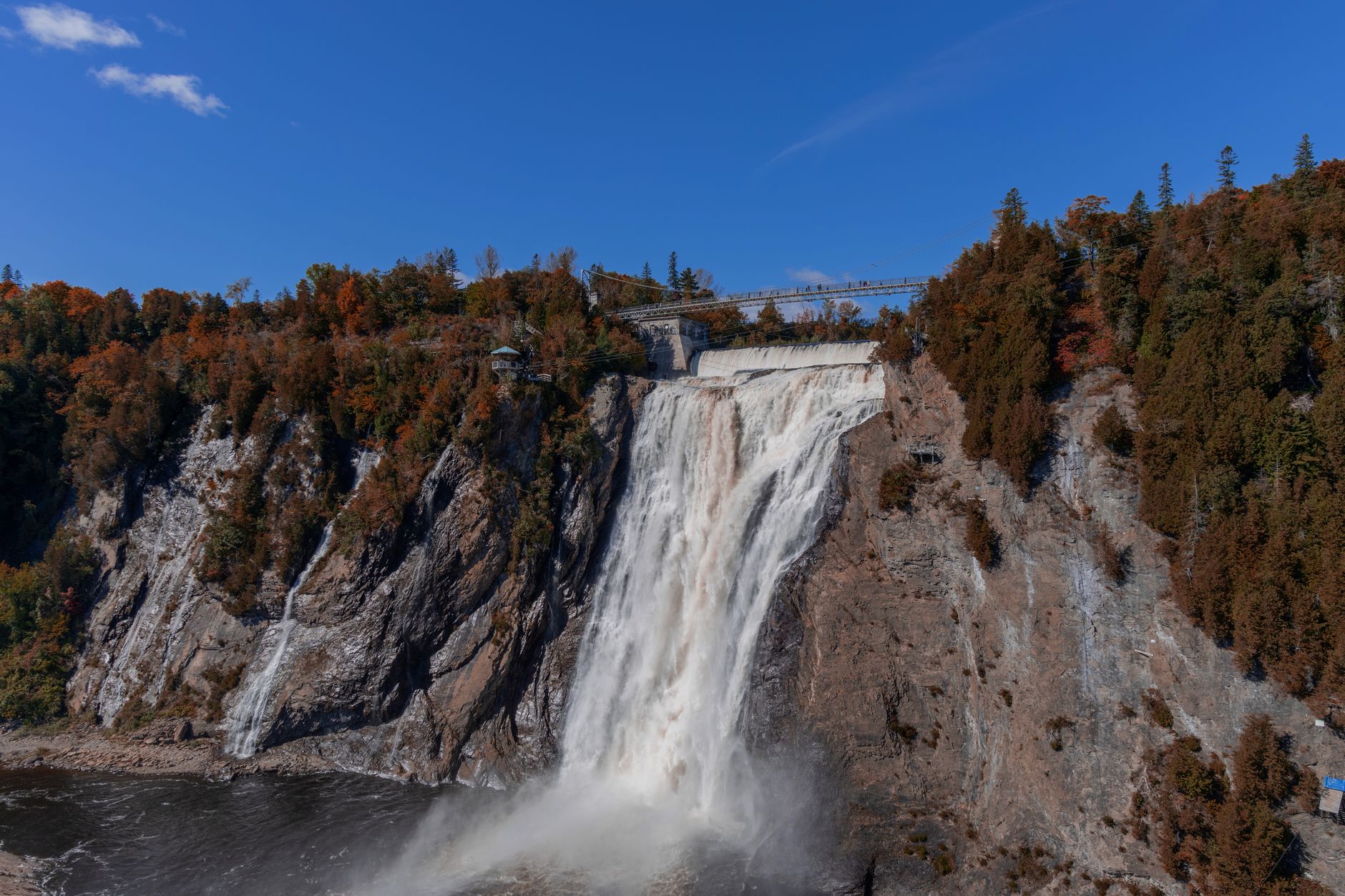
You hear it before you see it. Montmorency Falls drops 83 meters, about 30 meters more than Niagara, off a cliff roughly 12 km from Old Quebec. Stand on the suspension bridge right above the drop and the roar swallows your voice while spray drifts onto your face.
In fall, the slopes around the water turn orange and red, which makes this the easiest big foliage view in the area. From the top you get the falls, the St. Lawrence River, Île d’Orléans and the city, all in one sweep.
Cable car or 487 steps?
From the lower park you’ve got two ways up. The glassed-in cable car takes a few minutes and shows the falls from every angle. The panoramic staircase has 487 wooden steps, with landings to catch your breath. Ride up, walk down: your legs will thank you and you still get every viewpoint.
Parking, entry and the cable car are priced separately or as combos, and rates change by season, so check the official Sépaq page for the falls before you go.
Getting there without a car
City bus 800 runs toward the falls from Place D’Youville in the upper town and Gare du Palais in the lower town. Plan on about 45 minutes each way. By car, it’s a 15 to 20 minute drive.
Île d’Orléans: apples, cider and pie by the roadside
Cross the island’s single bridge and everything slows down. Île d’Orléans is a working farm island about 15 minutes from the city, with stone houses, church steeples and orchards running down to the river.
One road, Route 368, loops all the way around. Driving it without stops takes about 90 minutes, but nobody drives it without stops. Plan half a day at least, a full day if you like tasting things.
Where to pick, sip and snack
- Cidrerie Verger Bilodeau: the island’s first cider mill, with pick-your-own apples, tastings and a small farm
- Domaine Orléans: the orchard closest to the bridge, known for free tastings and views toward Montmorency Falls
- Cassis Monna & Filles: blackcurrant liqueur and blackcurrant ice cream, an island favorite
- Sainte-Famille: the oldest parish, with wide orchard views across to Mont-Sainte-Anne
Pick-your-own season usually runs from September into October, depending on the variety and the weather. McIntosh, Cortland and Lobo are local staples. Each farm posts its own dates, so check before you drive out.
Public transport barely reaches the island. Drive, cycle if you don’t mind a few hills, or let someone else handle the wheel.
Jacques-Cartier National Park: where the valley catches fire
If Montmorency is the postcard, Jacques-Cartier is the full show. This park north of the city is a deep, steep-sided valley with a river at the bottom and more than 100 km of trails climbing through maple and birch.
From the lookouts, the valley walls look painted: red lower down, gold higher up, dark spruce on the ridges. It’s often one of the first places around the city to reach peak color.
Go early. Start hiking before 9am to beat the parking rush and catch soft light on the leaves. Roots and rocks get slippery under wet leaves, so wear shoes with real grip, and carry water because refills aren’t guaranteed on the main routes. Like other Sépaq parks, it charges a daily access fee.
There’s no practical public transport to the park, so this is the day a car pays for itself. Compare rental cars for your day trips and pick one up only for the days you leave town. You won’t want it in Old Quebec, where streets are narrow and parking is tight.
Short on time? Mont-Sainte-Anne, east of the falls, lets you ride a lift up and walk back down with wide views over the St. Lawrence; check its lift days before you go. The city’s tourism board keeps an updated list of the best places to see fall foliage around Quebec City if you want more options.
Beyond Old Town: neighborhoods where locals eat
Walk out through Porte Saint-Jean and the souvenir shops thin out within a few blocks. This is where Quebec City lives.
Saint-Jean-Baptiste
Rue Saint-Jean keeps going past the walls, lined with bakeries, chocolate shops, used bookstores and record shops on a steep, colorful hillside. Duck into J.A. Moisan, open since 1871 and often called the oldest grocery store in North America. The creaky floors and the smell of fresh bread are half the fun.
Saint-Roch
Down the hill, the old working-class district is now the city’s creative corner. Rue Saint-Joseph Est is lined with brewpubs, vintage shops, bistros and design stores. It’s the place for a long, lazy dinner with locals at friendlier prices than inside the walls.
Limoilou
Across the Saint-Charles River, Limoilou feels like a neighborhood nobody told the tourists about. Stroll 3e Avenue between 2e and 16e Rues for bakeries, cafés, craft shops and young chefs’ restaurants, then detour down 2e Avenue for red-brick houses with outdoor spiral staircases. Cartier-Brébeuf park, right on the river, is lovely when its trees turn.
Montcalm and the Plains of Abraham
Avenue Cartier is café-lined and a little posh. At its end sits the national fine arts museum, with the Plains of Abraham behind it: big lawns, old oaks and maples, and river views. In mid-October, this is the best free leaf walk inside the city.
What to eat in Quebec City in fall
Autumn is harvest season, and you taste it everywhere: squash on bistro menus, apple desserts, crates of fresh produce at the markets.
Start at Le Grand Marché de Québec, a bright public market in a restored pavilion on the ExpoCité site in Limoilou. It’s open daily and full of local producers: cheese, bread, maple products, craft beer and, in fall, piles of apples and squash. Graze your way through lunch.
Then work through the classics:
- Tourtière: a spiced meat pie, flaky and warming after a cold walk
- Pea soup: thick, smoky and exactly what a chilly evening wants
- Poutine: fries, cheese curds and gravy; the squeak of the curds tells you they’re fresh
- Pouding chômeur: a humble cake baked in hot maple or brown-sugar syrup, and dangerously easy to finish
- Maple everything: maple butter, maple candy and syrup on nearly anything that sits still
Yes, late-night poutine after a pub counts as a cultural experience. Yes, you’ll want another one the next day.
Where to stay for a fall trip
Old Quebec is the classic choice: step out the door into stone lanes and Château Frontenac views. It’s also the priciest, and early-October weekends fill up fast.
For better value and more local flavor, look at Saint-Jean-Baptiste or Saint-Roch. You’re a short walk from the old town (uphill from Saint-Roch), surrounded by good restaurants, and closer to Limoilou and the market. If your dates hit peak color or Thanksgiving weekend, book as early as you can.
A fall weekend in Quebec City, sorted
- Day 1: Old Quebec in the morning before the tour groups, lunch on Rue Saint-Jean, a sunset walk on the Plains of Abraham
- Day 2: Montmorency Falls first thing, then Île d’Orléans for apple picking, cider and pie; dinner in Saint-Roch
- Day 3: an early drive to Jacques-Cartier for a valley hike, or a slow day between the Grand Marché and 3e Avenue
Skip this, do that: skip Rue du Petit-Champlain at midday, when it’s shoulder to shoulder. Go around 8am instead, when it’s nearly empty and the morning light hits the painted shopfronts.
Questions travelers ask
When is peak fall foliage in Quebec City?
Usually late September to mid-October. The hills north of the city tend to peak first, and parks inside the city often look best in mid-October. Early October is the safest single week.
Can you visit Montmorency Falls without a car?
Yes. City bus 800 runs from the upper and lower town toward the falls in about 45 minutes. Half-day tours from Old Quebec also go there, often combined with Île d’Orléans.
Is Île d’Orléans worth visiting in October?
Very much. Orchards, cideries and farm stands are in full harvest mode, and the island’s maples turn at the same time. Go early in the month if you want to pick apples, since many orchards close after Canadian Thanksgiving.
What should I pack for Quebec City in the fall?
Layers. Bring a warm sweater, a windproof jacket, a hat and light gloves for evenings, plus shoes with grip for hills, cobblestones and wet trails. A rain layer helps too.
Keep one evening free for the simplest thing in town. On a clear October night, grab something warm to drink, walk the Dufferin Terrace boardwalk beside the Château Frontenac, and watch the ferry lights slide across the river to Lévis. You’ll already be planning the next trip.
Some links in this post are affiliate links. If you book through them, we may earn a small commission at no extra cost to you.
Cover photo by Clément Proust on Pexels