It’s 9am on a quiet practice slope, your skis finally point the same way, and the only sound is the lift humming overhead. That moment is exactly what the best Alps ski resorts for beginners are built for: gentle terrain close to the village, ski schools that know how to calm nervous first-timers, and an airport transfer that doesn’t swallow half your first day.
Pick the wrong resort and you’ll spend your week on icy red runs you never signed up for, or two extra hours in a minibus. Pick well and you’ll be riding a chairlift to lunch at a mountain hut by day four.
Below are six resorts across Austria, France, Italy and Switzerland that get the basics right, plus how to book lessons and transfers without the usual headaches. For more trip ideas beyond the snow, browse our worldwide travel guides and tips.
- Best for families with small kids: Serfaus-Fiss-Ladis, Austria
- Shortest transfers: Ellmau, Austria (about an hour from Innsbruck)
- Free beginner lifts: Alpe d’Huez, France
- Arrive by train: Wengen, Switzerland
- Time needed: a full week gives most first-timers enough days to reach easy blue runs
- Best months: January after the holidays, and March for softer snow and quieter slopes
What to look for in Alps ski resorts for beginners
Big famous resorts aren’t automatically good for learning. What matters is nursery slopes near your bed, cheap or free lifts while you practice, and an easy step up from the baby slope to longer runs.
Altitude matters too. Higher resorts hold snow better early and late in the season. Lower ones can be cheaper and cozier, but a warm week turns their slopes soft and heavy.
Then there’s the trip itself. A two-hour transfer feels fine on paper. After an early flight with kids and ski bags, it feels like a small expedition.
Serfaus-Fiss-Ladis, Austria: built for first turns (and tiny skiers)
Three sunny villages sit on a high plateau above the Inn Valley, and Serfaus keeps its center car-free with a little underground railway that whisks you to the lifts. The slopes run from about 1,200m to 2,820m, so the snow tends to stick around well into spring.
Adult beginners ride the Komperdell gondola up to gentle learning zones, while kids get their own snow playgrounds: Kinderschneealm and Murmli Park in Serfaus, Berta’s Kinderland in Fiss, all moving carpets, cheerful mascots and slopes so mellow a toddler can’t build up much speed. The official Serfaus-Fiss-Ladis ski school page lists the course options.
Getting there: Innsbruck airport is roughly an hour to 75 minutes by road. Munich takes around 2.5 to 3 hours. Trains run to Landeck-Zams, with a bus or taxi up the hill.
The catch: it’s one of Austria’s pricier family resorts, and ski school spots in school-holiday weeks go early. Ladis is usually kinder on your wallet, with the same lift pass.
Ellmau, Austria: short transfers and friendly blues
Ellmau sits in a broad valley under the jagged grey walls of the Wilder Kaiser, church spire in the middle and the smell of schnitzel drifting out of the guesthouses. It’s part of the SkiWelt Wilder Kaiser-Brixental, one of Austria’s largest linked ski areas, with more than 270km of pistes.
The wide nursery slopes sit right by the village, so you can pop back for a coffee (or a nap) between sessions. Once your snowplough behaves, the Hartkaiserbahn funicular takes you to a beginner area up top and gentle blues heading down from Hartkaiser. Neighboring Scheffau even has a free practice lift. Check the SkiWelt’s Ellmau page for the area map.
Getting there: about an hour from Innsbruck, roughly 1h15 from Salzburg and 1h30 from Munich by road. Trains stop at Wörgl or Kufstein, then it’s a short bus or taxi ride.
The catch: the local slopes are low. Serious snowmaking and north-facing runs keep them skiable, but a mild spell turns the lower pistes slushy. For a surer white week in early season or late March, go higher.
Alpe d’Huez, France: free lifts and big sunshine
Locals call it the island in the sun, and on a clear morning you’ll get it: bright light bouncing off wide, open slopes and café terraces full by 11am. The village sits at 1,860m, lifts climb to 3,330m, and the Grand Domaine links around 250km of runs.
Here’s the beginner win: a few learner lifts in the village are free, so you don’t need a full pass on day one. When you’re ready, a cheaper beginner pass opens most of the lifts. The Les Bergers area is a slow zone of rolling greens, and long greens from Les Jeux carry you back to town.
Getting there: Grenoble airport is roughly 1.5 hours away, Lyon around 2 hours, Geneva 2.5 hours or more. Many shared shuttles run mainly on Saturdays.
The catch: the top of the mountain is serious (the 16km Sarenne black starts up there), so stay in the lower zones until you’re confident.
Alta Badia, Italy: blue runs and ski huts worth stopping for
Pale Dolomite cliffs turn pink at sunset above Corvara, and the air smells of woodsmoke and speck. Alta Badia’s villages (Corvara, Colfosco, La Villa, San Cassiano and Badia) share about 130km of slopes, and more than half of them are blue.
The Col Alt gondola from Corvara drops you onto the Pralongià plateau: wide, rolling blues with a mountain hut every few turns. It’s the gentlest corner of the whole Sella Ronda area, and the Dolomiti Superski pass covers a huge linked network for when your legs want more.
Getting there: Innsbruck is around 2 to 2.5 hours away; Venice and Treviso around 2.5 to 3 hours. Bolzano is closer but has few international flights.
The catch: Corvara is one of Italy’s pricier ski villages, and Colfosco sits in shade through the darkest weeks of winter. Traveling with non-skiers? Our guide to Dolomites viewpoints anyone can reach without hiking has them covered, and there’s more in our Dolomites travel guides.
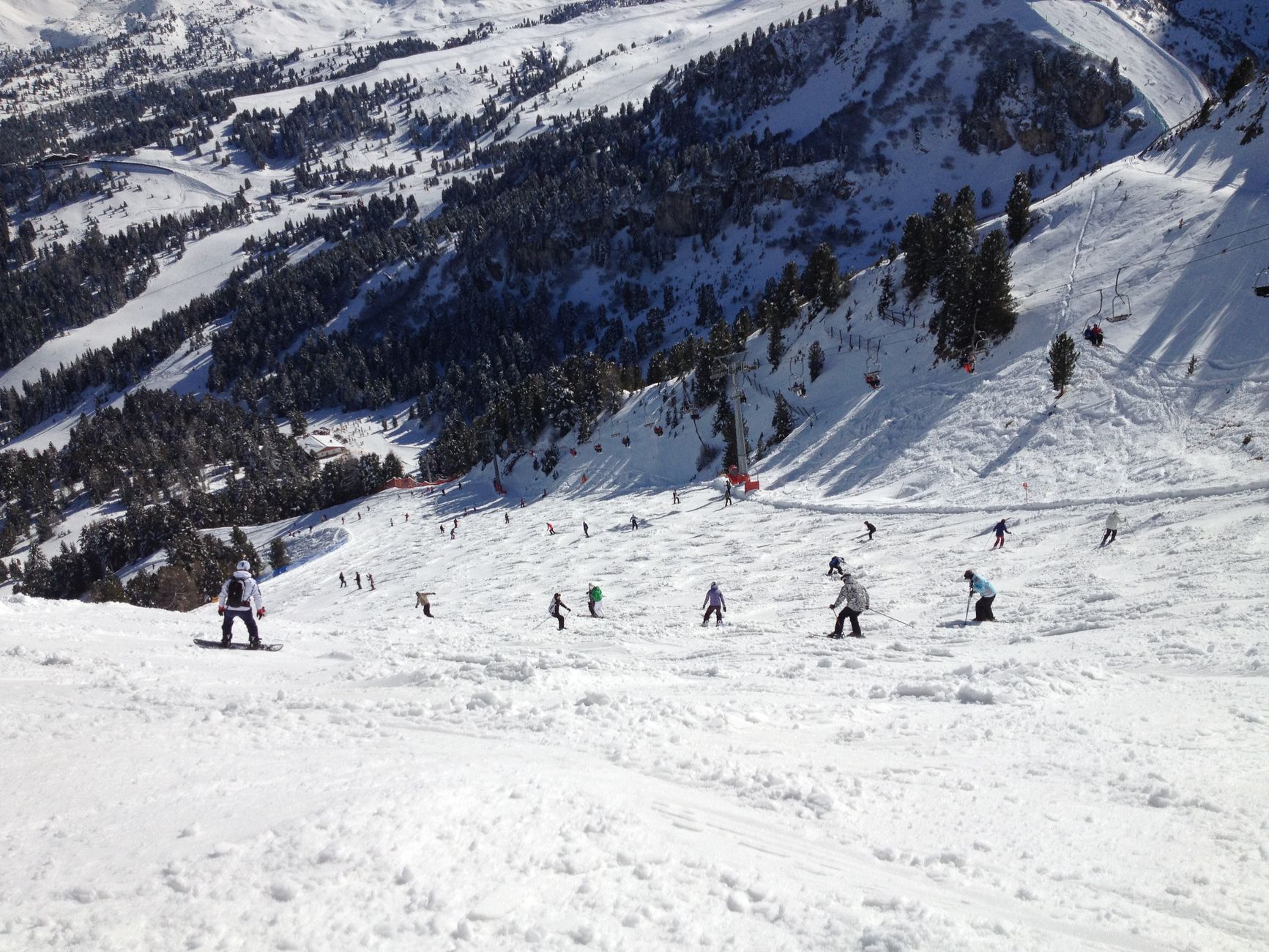
Wengen, Switzerland: arrive by train, learn under the Eiger
No cars here, just a cog railway that creaks up the cliff from Lauterbrunnen in about 15 minutes. Step off and the Eiger, Mönch and Jungfrau fill the sky. Wengen shares the Jungfrau ski region with Grindelwald and Mürren.
Beginners get nursery slopes in the village itself, slow-speed slopes at Kleine Scheidegg and wide, sunny terrain at the top of the Männlichen gondola, where learning comes with one of the best views in the Alps. English-speaking instructors are easy to find.
Getting there: Swiss trains take you from Zurich airport to Wengen in roughly 2.5 to 3 hours, changing at Interlaken Ost and Lauterbrunnen. From Geneva, allow closer to 3.5 to 4. Weighing up a rail pass? Here’s when the Swiss Travel Pass pays off and when single tickets win.
The catch: Switzerland is expensive, and moving between ski areas often means hopping on a train. Charming the first time. Less charming on day five with skis on your shoulder.
Cervinia, Italy: high, snow-sure and gloriously long
The Matterhorn towers over the village like a giant shark fin, and the snow squeaks underfoot on cold mornings. Cervinia sits around 2,050m with lifts climbing towards 3,500m on the Italian side, which makes it one of Italy’s most snow-sure resorts.
It shines once you’ve had a few days of lessons. The runs are long and gentle, perfect for racking up miles on easy terrain without a nasty steep bit hiding round the corner. The lifts link to Zermatt over the Swiss border, which is fun later in the week, but watch the last lift back: miss it and you face a very expensive taxi ride around the mountain.
Getting there: Turin airport is around 1h45 away, Milan Malpensa about 2.5 hours, Geneva roughly 2h45. No train reaches the resort; the nearest station is Châtillon/Saint-Vincent, with buses up the valley.
The catch: altitude means cold, windy days and flat light when cloud rolls in. Weekends get busy with Italian day-trippers.
Booking ski lessons without the stress
Lessons are the single best money you’ll spend on a first ski trip. Friends mean well, but they’ll take you up a run you’re not ready for by Tuesday.
- Book before you fly, especially for school-holiday weeks. Popular ski schools fill their beginner groups early.
- Group or private: group lessons cost less and are social. One or two private hours are great for fixing a specific problem, like turning left (everyone has a bad side).
- Be honest about your level. Most schools sort you by whether you can use a moving carpet, a drag lift or a chairlift. Overselling yourself means a scary first morning.
- Kids: ski kindergartens and childcare book up fast in family resorts, so reserve them with your accommodation.
A rough first week looks like this: day one on the nursery slope and moving carpet, days two and three on drag lifts and your first easy run, day four on a proper chairlift, and days five and six cruising longer blues. Everyone’s pace differs, so treat it as a guide, not a deadline.
Airport transfers: what first-timers get wrong
The closest airport isn’t always the easiest. Bolzano is near Alta Badia but has few international flights, and the ring roads around Munich clog up on busy weekends.
- Avoid Saturday if you can. It’s changeover day at most resorts, so roads are busiest and transfers are often pricier. Midweek arrivals are usually calmer and cheaper.
- Add time for snow. A fresh dump can add an hour to mountain roads, and drivers need winter tires or chains.
- Shared or private: shared shuttles cost less per person but may wait for other flights. With kids, car seats and ski bags, it’s often simpler to pre-book a private airport transfer to your resort.
- Consider the train in Switzerland and Austria. Wengen is built around it, and Ellmau and Serfaus-Fiss-Ladis both have stations within a short bus ride.
Where to stay as a first-timer
Location beats luxury. Sleep within walking distance of the nursery slope and your ski school meeting point, and your mornings get a lot calmer. Clomping 15 minutes through town in ski boots is nobody’s idea of fun.
In Austria, half board is common in family hotels, which saves you hunting for dinner after a tiring day. In Serfaus-Fiss-Ladis, stay in Serfaus or Fiss with little ones, or Ladis for better value. In Alpe d’Huez, look for places near the free beginner lifts. In Cervinia, check whether your hotel runs a shuttle to the lifts.
Before you go: gear, timing and insurance
Rent skis, boots and a helmet in resort. Boots matter most: if they pinch in the shop, they’ll hurt all week, so ask to swap. Bring your own gloves, a buff and goggles, plus sunscreen, because the sun at altitude is stronger than it feels.
For timing, early January (after New Year) and March tend to be quieter and better value. Christmas, New Year and February school holidays are the busiest weeks across the Alps.
Falls are part of learning, so sort travel insurance that clearly includes winter sports. Many standard policies need an add-on for skiing; read the policy wording before you buy.
Questions travelers ask
Which country in the Alps is best for beginner skiers?
Austria is a favorite for first-timers thanks to village nursery slopes, family-friendly ski schools and short transfers from Innsbruck and Salzburg. France offers big high-altitude areas and free beginner lifts in some resorts, and Italy’s Dolomites have lots of wide blue runs.
How many ski lessons does a beginner need?
Most first-timers do best with lessons on most days of their first week, often a morning group lesson followed by an afternoon of practice. A couple of private hours can speed things up if you get stuck.
Is Switzerland too expensive for a first ski trip?
It’s usually the priciest option, but resorts like Wengen make up for it with car-free villages, easy train access and superb scenery. If budget is tight, Austria’s SkiWelt or Italy tend to offer better value.
What’s the easiest airport for Alps ski resorts for beginners?
It depends on the resort: Innsbruck for Tyrol, Grenoble for Alpe d’Huez, Zurich for Wengen and Turin for Cervinia. Check how often transfers run from each one before you book flights.
When is the best time for a first ski trip to the Alps?
January after the holidays usually brings quieter slopes and good snow, while March offers longer, sunnier days and softer snow that’s kinder when you fall. Avoid the peak holiday weeks if you want space on the nursery slope.
One last thing: book your first lesson for the morning after you arrive, not the same afternoon. You’ll have the evening to collect rental gear and walk to your meeting point, and that first glide down the practice slope will feel even sweeter after a proper night’s sleep.
Some links in this post are affiliate links. If you book through them, we may earn a small commission at no extra cost to you.
Cover photo by Tobi &Chris on Pexels


