Three days of Roman cobblestones, Vatican queues and scooters at your heels, and a morning on a fast train with a coffee and a window seat starts to look very good. The best day trips from Rome by train drop you somewhere completely different in under two hours, with no rental car, no tour bus and no parking to find.
Italy’s rail network makes this easy. Two companies, Trenitalia and Italo, run high-speed trains out of Roma Termini, and slower regional trains reach the hill towns and the coast for the price of a sandwich.
Here are seven that are worth the ticket, from Renaissance Florence to the Roman port town most visitors never hear about.
- Fastest big-city trips: Florence and Naples, each around 70 to 90 minutes on a high-speed train
- Best for ancient ruins: Pompeii for the full experience, Ostia Antica for the short and cheap version
- Best small-town escape: Orvieto
- Cheapest: Ostia Antica and Frascati, both on low-cost local tickets
- Main stations: Roma Termini for most trips, Tiburtina for Tivoli, Porta San Paolo (next to Piramide metro) for Ostia Antica
How day trips from Rome by train work
There are two kinds of train you’ll use, and they work very differently.
High-speed trains (Trenitalia’s Frecciarossa and Italo) come with an assigned seat, and prices move like airline fares. Book a few days or weeks ahead and you’ll often pay a fraction of the walk-up price. Buy on the day and you might pay double.
Regional trains are the opposite. The fare is fixed and cheap, there are no seat numbers, and buying at the station on the morning is fine. If you end up with a paper regional ticket, validate it in the machine on the platform before you board. Inspectors do fine people who forget, and “I’m a tourist” doesn’t work.
Two practical things catch people out at Termini. Some regional trains leave from far-end platforms that take about ten minutes to walk to, so don’t cut it fine. And the ticket machines and the official Trenitalia site show the same fares, so skip the “helpers” who hover around the machines offering to assist.
Aim to leave Rome by 8am for anything over an hour away. You’ll beat the tour groups and still have time for a proper lunch.
1. Florence: the big one
High-speed trains run from Roma Termini to Firenze Santa Maria Novella several times an hour, and the ride takes around an hour and a half. That makes Florence the most popular day trip from Rome, and the station drops you a ten-minute walk from the cathedral.
Don’t try to do everything. The Duomo, the Ponte Vecchio and a wander through the Oltrarno are enough for most people. Add one museum, not three. The Uffizi is the obvious pick, and the queue without a timed ticket can eat your whole morning, so book a timed Uffizi entry before you go.
Save the last hour for the walk up to Piazzale Michelangelo. The view over the red roofs is the one on every postcard, and it’s free.
The honest downside: in summer the centre is packed and hot, and one day only scratches the surface. If you’re torn, Florence is the trip on this list most worth turning into an overnight stay.
2. Naples: pizza, noise and a great museum
Naples is only about 70 minutes from Rome on the fast train, and it feels like a different country. Louder, messier and far cheaper, it’s where pizza was born, and a margherita at one of the old pizzerias near Via dei Tribunali costs less than a coffee near the Pantheon.
Walk Spaccanapoli, the long straight street that slices through the old town, then duck into the National Archaeological Museum. It holds many of the best mosaics and frescoes taken from Pompeii, so it’s worth an hour even if you’re heading to the ruins another day.
Keep your phone and wallet out of reach around Napoli Centrale and on crowded streets. Pickpocketing is a real problem here, more than in Rome.
3. Pompeii: a long day, but worth it
Pompeii is the most famous of all the day trips from Rome by train, and also the most tiring. Plan on two to three hours each way.
First, take a high-speed train to Napoli Centrale. Then follow the signs downstairs to Napoli Garibaldi, the Circumvesuviana station underneath the main one. Local trains toward Sorrento leave roughly every half hour and take about 35 to 40 minutes. Get off at Pompei Scavi – Villa dei Misteri, right by the entrance, not at the other Pompei stop. Tickets are a few euros and you can’t reserve seats, so just buy at the station.
The Circumvesuviana is hot, crowded and slow, with no air conditioning on most trains and a reputation for pickpockets. From spring to autumn, the Campania Express tourist train runs the same line with fewer stops and reserved seats for a higher fare. It’s worth it in summer.
Once inside, the site is huge and has almost no shade. Bring water and a hat, wear real shoes, and leave big bags behind, since large luggage isn’t allowed in. Without context, the ruins can blur into a maze of walls, and a guide makes a big difference. You can book a guided walk through Pompeii that meets you at the gate. Check tickets and opening days on the official Pompeii site.
Short on energy? Herculaneum, at the Ercolano Scavi stop on the same line, is smaller, better preserved and much quieter. Plenty of travelers who’ve seen both prefer it.
4. Orvieto: the easiest hill town
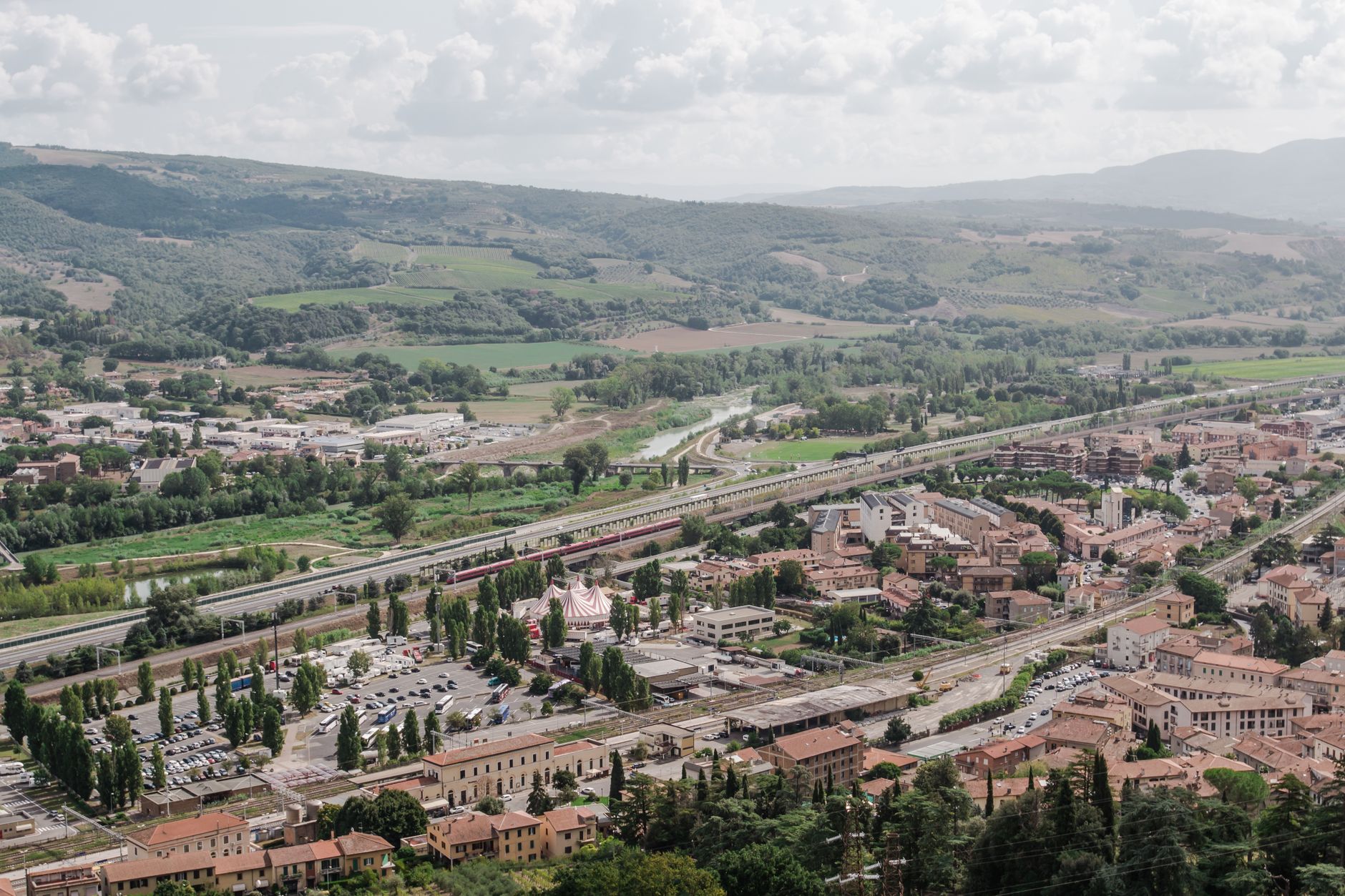
If you only do one small-town trip, make it Orvieto. It sits on the main line toward Florence, about an hour to an hour and a half from Rome depending on the train, and it’s built on top of a sheer block of volcanic rock.
The funicular is directly across the road from Orvieto station and climbs to the top in a couple of minutes for a cheap ticket. From there, walk down Corso Cavour to the cathedral, or hop on the shuttle bus. The Duomo’s gold mosaic facade is the reason people come, and it’s even better in late afternoon sun.
Near the top of the funicular, St Patrick’s Well is a deep, strange spiral staircase cut into the rock. Guided tours also take you into the caves and tunnels under the town. Stay for lunch with a glass of the local white wine, which is cheap and very good.
You’ll see Civita di Bagnoregio, the village on a crumbling hill, suggested as an add-on. It’s reached by bus from Orvieto and the buses aren’t frequent, so check the timetable before you commit.
5. Tivoli: two villas, one day
Tivoli sits in the hills east of Rome and has two UNESCO-listed villas that couldn’t be more different. Regional trains leave from Roma Tiburtina, which is on metro line B, and take roughly an hour.
Tivoli station is at the bottom of the hill. It’s about a 25-minute uphill walk into town, or a short ride on the local bus. Villa d’Este is right in the centre: a Renaissance garden with hundreds of fountains, including an organ fountain that plays music at set times through the day. Go early or late to see it without a crowd.
Hadrian’s Villa, the emperor’s sprawling country retreat, is several kilometres outside town. Don’t try to walk it. Take the local CAT bus from the centre and budget at least two hours on site.
Seeing both is a full, tiring day. If you only want an easy half day, Villa d’Este on its own works perfectly. Opening days change through the year, so check both before you go.
6. Ostia Antica: Rome’s old port, 30 minutes away
This is the best-value trip on the list. Take metro line B to Piramide, walk through to Porta San Paolo station next door, and catch the Roma-Lido train. It uses a normal Rome public transport ticket, the same one you’d use on the metro, and it takes about 30 minutes to reach Ostia Antica.
From the station, a footbridge crosses the road to the site. Inside you’ll find whole streets of shops, apartment blocks, baths, a theatre and floor mosaics you can walk right up to. It feels a lot like a smaller Pompeii, with a fraction of the crowds and no two-hour train ride.
The site is closed on Mondays. The Lido line also gets frequent engineering works, sometimes with replacement buses, so check the line status the night before. Bring a picnic and two transport tickets, one for the way back.
7. Frascati: wine and a slow lunch
Frascati is the closest escape of all. Regional trains from Termini take around 25 to 30 minutes, run roughly every hour and cost very little.
There isn’t a long list of sights here, and that’s the point. Walk up from the station into the old centre, buy a porchetta sandwich from a stall, and sit down in a cantina with a jug of the local white wine. The terraces look back across the plain to Rome.
It’s the right trip for a slow day between big sightseeing days, or for an afternoon when you’ve simply had enough of crowds. Several family wineries around town run tastings if you want more than a jug.
Questions travelers ask
What is the easiest day trip from Rome by train?
Orvieto and Frascati are the simplest. Both are direct regional trains with cheap fixed fares, and neither needs advance booking. Ostia Antica is close behind if you’re comfortable changing from the metro to the Lido line.
Do I need to book Italian train tickets in advance?
For high-speed trains to Florence or Naples, yes, if you want a good price. Fares rise as the date gets closer. Regional trains have fixed prices, so you can buy them at the station on the day.
Can you really do Pompeii as a day trip from Rome?
Yes, but it’s a long day. Expect two to three hours each way with the change in Naples, and leave Rome early so you get four or five hours on site.
Which Rome station do day-trip trains leave from?
Most leave from Roma Termini. Trains to Tivoli go from Tiburtina, and the train to Ostia Antica leaves from Porta San Paolo, next to Piramide metro station.
One last tip: before you leave Rome, look up the last direct train back and set a phone alarm an hour before it. Regional services thin out in the evening, and missing the final train from a small hill town is the one way a cheap day trip gets expensive.
Some links in this post are affiliate links. If you book through them, we may earn a small commission at no extra cost to you.
Cover photo by Wolfgang Weiser on Pexels
